

Little Urchin
Some filters could not be applied and were reset.
-
 Sold out Little Urchin Natural Tinted Sunscreen SPF 30 $28.95
Regular price $29.95 -
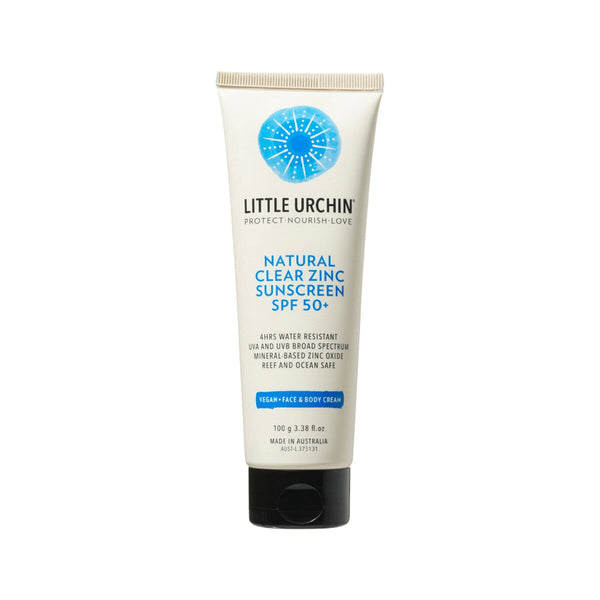 Sale Little Urchin Natural Sunscreen Clear Zinc SPF50+ $28.95
Regular price $29.95Add to cart -
 Sold out Little Urchin Baby Natural Zinc Stick Clear Spf 50+ $16.95
-
 Little Urchin Face Natural Clear Zinc Sunscreen Spf 50+ Pump $24.95 Add to cart
-
 Little Urchin Face Light/Medium Tint Natural Sunscreen Spf 50+ Pump $24.95 Add to cart
-
 Little Urchin Kids Natural Clear Zinc Sunscreen Spf 50 Pump $69.95 Add to cart
-
 Little Urchin Natural Clear Zinc Sunscreen Spf 50 Pump $69.95 Add to cart
-
 Sold out Little Urchin Kids Natural Sunscreen Clear Zinc Spf 50+ $28.95
Regular price $29.21


Little Urchin Information
Shop Little Urchin sunscreen at Mr Vitamins. Little Urchin makes zinc oxide sunscreens, and zinc oxide is the only active ingredient in every one we stock. We stock the SPF 50+ tube, stick and face pumps, and SPF 50 family pumps in 300 g, including a Kids pump. Each one is a listed medicine with an AUST L number. Our qualified naturopaths and nutritionists offer a free 10-minute online consultation, so you can choose with expert advice. In store, you can walk in any time for free advice, with no appointment.
Shop Little Urchin by type. Tube: Clear Zinc SPF 50+ 100 g. Stick: Clear Zinc Stick SPF 50+ 20 g. Face pumps: Face Clear Zinc SPF 50+ and Face Light/Medium Tint SPF 50+. 300 g family pumps: Clear Zinc SPF 50 and Kids Clear Zinc SPF 50.
| Type | SPF on the label | Size | Typical price | About per 100 g |
|---|---|---|---|---|
| Stick | SPF 50+ | 20 g | About $17 | About $85 |
| Face pumps, clear or tinted | SPF 50+ | 50 g | About $25 | About $50 |
| Tube | SPF 50+ | 100 g | About $29 | About $29 |
| Family pumps, adult or Kids | SPF 50 | 300 g | About $70 | About $23 |
These are current prices for in-stock products, and prices change often.
Sunscreen is one part of sun protection, along with clothing, a broad-brimmed hat, shade and sunglasses. Avoid long periods in strong sun, and use sunscreen often, reapplying as the label directs.
Always read the label and follow the directions for use.
What Little Urchin Sunscreens Are Listed For
Sunscreens with an AUST L number can only carry indications set by the TGA for sunscreens[1]. The Little Urchin sunscreens we stock carry these:
- Very high or high protection: the tube, stick and face pumps are listed as SPF 50 PLUS broad spectrum very high protection sunscreens. The 300 g pumps are listed as SPF 50 broad spectrum high protection sunscreens.
- Skin cancer risk: the stick, face pumps and 300 g pumps may reduce the risk of some skin cancers.
- Skin ageing and sunspots: the same products can aid in the prevention of premature skin ageing and sunspots.
Daily sunscreen was studied by Adèle Green and colleagues at the Queensland Institute of Medical Research, in a trial of 1,621 adults in Nambour, Queensland. After 4.5 years, the daily sunscreen group had about 39% fewer squamous cell skin cancer tumours, though no fewer basal cell skin cancers[2]. Adults under 55 in the daily group also showed 24% less skin ageing than people who used sunscreen when they chose[3]. The trial used an SPF 15+ broad spectrum sunscreen, not a Little Urchin product. The National Health and Medical Research Council funded it[3].
Always read the label and follow the directions for use. If symptoms persist, talk to your health professional.
How to Choose a Little Urchin Sunscreen
- SPF 50+ or SPF 50: SPF 50+ is the top label rating, "very high protection", and SPF 50 is "high protection"[1]. Cancer Council recommends either[5]. Every Little Urchin sunscreen we stock is also broad spectrum.
- Face or body: the 50 g face pumps have ceramide 3, jojoba and pink algae in the base. The tube and 300 g pumps suit larger areas.
- Stick or cream: the 20 g stick suits a pocket or school bag. Apply it generously and evenly on all exposed skin, as a stick can be easy to under-apply[7].
- Clear or tint: the Face Light/Medium Tint pump is coloured with iron oxides. All the others are clear zinc.
- Allergies: the Kids 300 g pump contains soya oil, so it does not suit anyone with a soy allergy.
- Still unsure: book a free 10-minute online consultation, or ask in any of our stores.
How to Apply and Reapply Sunscreen
Most people apply far less sunscreen than they need[5]. Cancer Council suggests about one teaspoon (5 mL) for each arm, each leg, the front of your body, your back, and your face, neck and ears. That is about seven teaspoons, or 35 mL, for an adult's whole body[4].
- Apply to clean, dry skin 20 minutes before you go outside.
- Reapply at least every two hours, and after swimming, sweating or towel drying[4]. Little Urchin labels say every 1 to 2 hours, so follow the label.
- Use sunscreen every day when the UV Index is forecast to be 3 or above[4].
- Pair sunscreen with clothing, a broad-brimmed hat, shade and sunglasses. No sunscreen gives full protection on its own[5].
Sunscreen for Babies and Kids
Cancer Council recommends keeping babies under 12 months away from direct sunlight when UV levels reach 3 or above. Shade, clothing and hats come first for babies. The widespread use of sunscreen on babies under six months is not generally recommended[6].
From six months, use sunscreen as the last line of defence, after shade, clothing and a hat[6]. The Kids 300 g pump is an SPF 50 broad spectrum sunscreen, and its size suits school, sport and weekends.
Zinc Oxide and Nanoparticles Explained
Zinc oxide is a mineral UV filter. It is the only active ingredient in each Little Urchin sunscreen we stock, at 227.5 mg per gram (22.75%) in the creams and 245 mg per gram (24.5%) in the stick.
Nanoparticles are particles smaller than 100 nanometres (a nanometre is a millionth of a millimetre)[5]. A sunscreen labelled "non-nano" uses zinc particles larger than that. The TGA has reviewed the research on nanoparticles in sunscreens. Cancer Council reports its conclusion that, on the best available evidence, nanoparticles used in sunscreens do not pose a risk to health[5].
How to Read a Sunscreen Label
- AUST L number: this shows the sunscreen is a listed medicine on the Australian Register of Therapeutic Goods (ARTG). Its claims must come from the TGA's list of permitted sunscreen indications[1].
- SPF: the sun protection factor, up to SPF 50+ on Australian labels[1].
- Broad spectrum: protection against both UVA and UVB radiation[5].
- Water resistance: some labels state a time, such as "4 hours water resistant". That figure comes from lab testing, so reapply after swimming, sweating or towel drying anyway[5].
- Directions: primary sunscreen labels must tell you, or say words to the effect, to avoid prolonged sun exposure, wear protective clothing, hats and eyewear, and reapply every two hours[7].
Why Buy Little Urchin from Mr Vitamins
- Trusted since 1992, with eight stores across Sydney, the Hunter region and the Sunshine Coast.
- Qualified naturopaths and nutritionists in store and online.
- A free 10-minute online consultation, with no obligation to buy.
- Free Click & Collect.
- Free standard shipping on orders over $120 in NSW and the ACT, and over $150 in QLD, VIC, SA, TAS and WA.
- Our team aims to dispatch in-stock orders the same day.
- Rated 4.7 stars from more than 3,200 reviews.
Explore more in Natural Sunscreens, Natural Kids Sunscreen, Natural Sun Care and Natural After Sun Care.
References
- Therapeutic Goods (Permissible Indications) Determination (No. 1) 2025 (Cth), F2025L00450, Schedule 1, Part 16 (sunscreen indications). Available at: https://www.legislation.gov.au/F2025L00450/latest.
- Green, A. et al. (1999) 'Daily sunscreen application and betacarotene supplementation in prevention of basal-cell and squamous-cell carcinomas of the skin: a randomised controlled trial', The Lancet, 354(9180), pp. 723-729. Available at: https://doi.org/10.1016/S0140-6736(98)12168-2. Funding: National Health and Medical Research Council of Australia (as reported for the same trial in Hughes et al. 2013).
- Hughes, M.C.B. et al. (2013) 'Sunscreen and prevention of skin aging: a randomized trial', Annals of Internal Medicine, 158(11), pp. 781-790. Available at: https://doi.org/10.7326/0003-4819-158-11-201306040-00002. Funding: National Health and Medical Research Council of Australia.
- Cancer Council Australia (n.d.) How to protect your skin from the sun. Available at: https://www.cancer.org.au/cancer-information/causes-and-prevention/sun-safety/preventing-skin-cancer/how-to-apply-sunscreen (Accessed: 10 November 2026).
- Cancer Council Australia (n.d.) Fact sheet: Sunscreen. National Cancer Prevention Policy. Available at: https://www.cancer.org.au/about-us/policy-and-advocacy/prevention/uv-radiation/related-resources/fact-sheet-sunscreen (Accessed: 10 November 2026).
- Cancer Council Australia (2017) Fact sheet: Sun protection and babies. National Cancer Prevention Policy. Available at: https://www.cancer.org.au/about-us/policy-and-advocacy/prevention/uv-radiation/related-resources/sun-protection-babies (Accessed: 10 November 2026).
- Therapeutic Goods (Standard for Labelling of Non-Prescription Medicines) (TGO 116) Order 2026 (Cth), F2026L01312, section 29 (sunscreen preparations). Available at: https://www.legislation.gov.au/F2026L01312/latest.